Charder's Body Composition Analyzers provide detailed measurements for body water, fat, muscle, cellular health, and more! Data is arranged clearly on easy-to-interpret result sheets, suitable for different application needs.
Medical Result Sheet
Athletic Result Sheet
Child Result Sheet
Medical Result Sheet
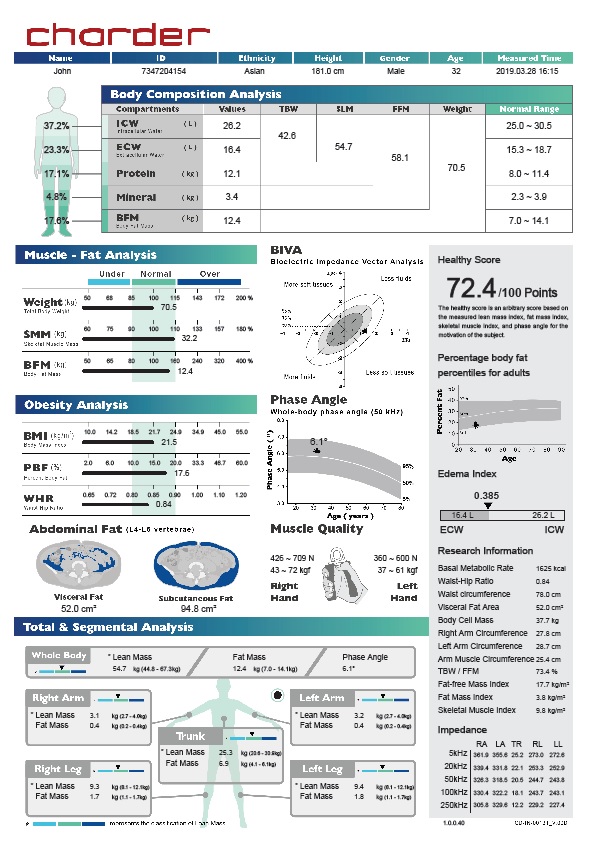
MA801 Medical Result Sheet
(1) Body Composition Analysis
Reliable, non-invasive Bioelectrical Impedance Analysis makes it easier to conduct regular monitoring of Body Composition. The calculated estimated weights of the body's compositional elements can be compared with standard results for context.
(2) Muscle-Fat Analysis
Measurement of weight is important, but incomplete without further analyzing the amount of muscle and fat in a client. Understanding skeletal muscle and body fat proportions can help trainers formulate muscle and fat control recommendations.
(3) Obesity Analysis
Different body fat indicators provide valuable information needed for a more useful evaluation of health. Percent Body Fat is a general indicator, while Waist-Hip Ratio and Visceral Fat are used as critical cut-off points for risk of obesity-related diseases which may not be immediately visible from the outside.
(4) Total & Segmental Analysis
Measure muscle and fat more precisely with segmental analysis of the trunk, upper body, and lower body. Identify imbalances, and determine if segmental muscle is within normal range, tracking changes to better observe the effects of rehabilitation or training.
Bioelectrical Vector Impedance Analysis (BIVA) uses direct measurements of reactance and resistance, allowing it to provide reliable comparisons and evaluations of cellular hydration and nutritional status - even for individuals with abnormal hydration - making it easier for trainers to recommend detailed health checks if needed, helping to keep clients safe.
(6) Phase Angle
Phase angle decreases with illness and old age, making it an important indicator of health, and an absolute necessity for a professional body composition evaluation. Compare phase angle with respective gender and age, placing results into context.
(7) Muscle Quality
Track changes in quality, not just quantity! In elderly populations, muscle strength can decline much more rapidly than muscle mass. By evaluating muscle effectiveness through cellular estimation of grip strength health, professionals now have a more useful indicator that may provide early warning for fall risk.
(8) Body Fat Percentiles
Compare body fat percentages with similar population, placing results in context of age, gender, and ethnicity.
(9) Edema Index
Identify abnormalities in intracellular/extracellular fluid proportion, using the edema index as an indicator and warning sign for diseases affecting body fluid balance, including impaired heart and function.
(10) Research Information
The MA801 provides a wide variety of body composition output parameters of particular relevance for research, and includes various indexes used as early warning signs for malnutrition, obesity, and sarcopenia.
Athletic Result Sheet
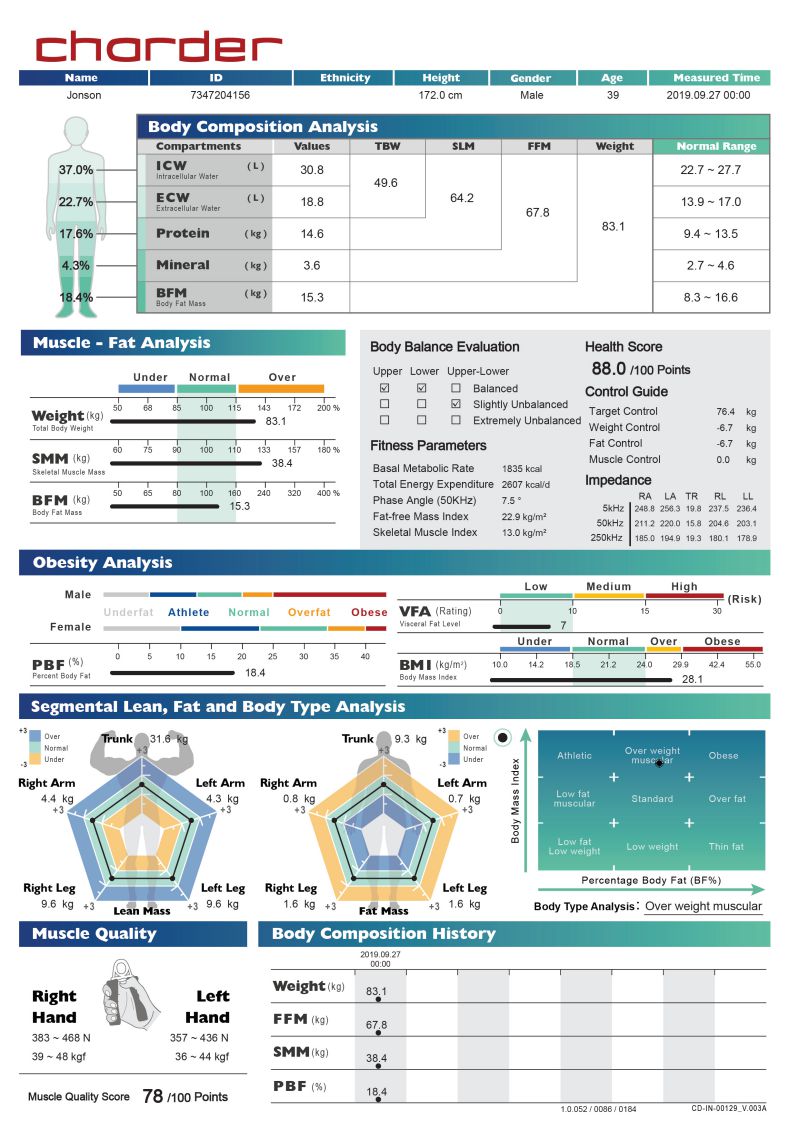
MA601 Athletic Result Sheet
(1) Body Composition Analysis
Reliable, non-invasive Bioelectrical Impedance Analysis makes it easier to conduct regular monitoring of Body Composition. The calculated estimated weights of the body's compositional elements can be compared with standard results for context.
(2) Muscle-Fat Analysis
Measurement of weight is important, but incomplete without further analyzing the amount of muscle and fat in a client. Understanding skeletal muscle and body fat proportions can help trainers formulate muscle and fat control recommendations.
(3) Obesity Analysis
The MA601 categorizes body fat ranges into those commonly seen for Underfat, Athlete, Normal, Overfat, and Obese populations. With more precise ranges, fat control goals and progress can be tracked more accurately. Visceral Fat Level is related to Abdominal Visceral Fat Area, and is used as an indicator for risk of obesity-related diseases.
(4) Segmental Analysis
Measure muscle and fat more precisely with segmental analysis of the trunk, upper body, and lower body. Identify imbalances, and determine if segmental muscle is within normal range, tracking changes to better observe the effects of rehabilitation or training.
(5) Body Type Analysis
The body type analysis chart combines BMI and Percent Body Fat to determine the subject's body type. Body composition changes needed to achieve ideal body type can be clearly determined using this clear and simple chart.
(6) Muscle Quality
Track changes in quality, not just quantity! In elderly populations, muscle strength can decline much more rapidly than muscle mass. By evaluating muscle effectiveness through cellular estimation of grip strength health, professionals now have a more useful indicator that may provide early warning for fall risk.
(7) Body Composition History
By selecting the same user ID prior to measurement, changes in body composition can be tracked automatically (Weight, Fat-Free Mass, Skeletal Muscle Mass, and Percent Body Fat).
(8) Fitness Parameters
The MA601 provides multiple body composition output parameters of particular relevance for fitness, and includes various indexes used as early warning signs for malnutrition and sarcopenia. Make use of Phase Angle for evaluation of cellular health, and analyze health status in more detail.
(9) Health Score
The Result Sheet provides normal ranges for a variety of output, as well as an overall health score that takes into account a combination of results.
(10) Control Guide
The Control Guide calculates a recommended amount of muscle and fat control in order to reach an ideal, healthy body type.
Child Result Sheet
MA601 Athletic Result Sheet
(1) Body Composition Analysis
Reliable, non-invasive Bioelectrical Impedance Analysis makes it easier to conduct regular monitoring of Body Composition. The calculated estimated weights of the body's compositional elements can be compared with standard results for context.
(2) Muscle-Fat Analysis
Measurement of weight is important, but incomplete without further analyzing the amount of muscle and fat in a client. Understanding skeletal muscle and body fat proportions can help trainers formulate muscle and fat control recommendations.
(3) Obesity Analysis
The MA601 categorizes body fat ranges into those commonly seen for Underfat, Athlete, Normal, Overfat, and Obese populations. With more precise ranges, fat control goals and progress can be tracked more accurately. Visceral Fat Level is related to Abdominal Visceral Fat Area, and is used as an indicator for risk of obesity-related diseases.
(4) Segmental Analysis
Measure muscle and fat more precisely with segmental analysis of the trunk, upper body, and lower body. Identify imbalances, and determine if segmental muscle is within normal range, tracking changes to better observe the effects of rehabilitation or training.
(5) Body Type Analysis
The body type analysis chart combines BMI and Percent Body Fat to determine the subject's body type. Body composition changes needed to achieve ideal body type can be clearly determined using this clear and simple chart.
(6) Muscle Quality
Track changes in quality, not just quantity! In elderly populations, muscle strength can decline much more rapidly than muscle mass. By evaluating muscle effectiveness through cellular estimation of grip strength health, professionals now have a more useful indicator that may provide early warning for fall risk.
(7) Body Composition History
By selecting the same user ID prior to measurement, changes in body composition can be tracked automatically (Weight, Fat-Free Mass, Skeletal Muscle Mass, and Percent Body Fat).
(8) Fitness Parameters
The MA601 provides multiple body composition output parameters of particular relevance for fitness, and includes various indexes used as early warning signs for malnutrition and sarcopenia. Make use of Phase Angle for evaluation of cellular health, and analyze health status in more detail.
(9) Health Score
The Result Sheet provides normal ranges for a variety of output, as well as an overall health score that takes into account a combination of results.
(10) Control Guide
The Control Guide calculates a recommended amount of muscle and fat control in order to reach an ideal, healthy body type.